




 214-274-5008
Last Updated: October 25, 2026
Quick Summary
Choose durable work hoodies by starting with a heavyweight cotton-polyester blend in the 300-450 GSM range, then inspect stitching, seams, and hardware before buying. Check for double-needle stitching, bartacks at pocket corners, and rib-knit cuffs that spring back after stretching.
- An 80/20 or 90/10 cotton-poly blend is the sweet spot for most jobsite use.
- Aim for 300-450 GSM; below that, fabric wears thin fast.
- Zip and unzip the full length five times to test the zipper.
- Wash cold, tumble low, and skip fabric softener to extend hoodie life.
- Divide purchase price by expected wears to judge true value.
Table of Contents
- Start With the Best Fabric for Work Hoodies
- Check Fabric Weight and GSM Before You Buy
- Pick a Cotton Polyester Work Hoodie That Resists Wear
- Inspect Stitching, Seams, and Hardware
- Get the Work Hoodie Fit for Layering Right
- Plan Hoodie Care and Washing to Extend Its Life
- Use a Durability Checklist and Cost-Per-Wear Math
- Shop Hellanbach Hoodies Built for the Job
- Frequently Asked Questions
Start With the Best Fabric for Work Hoodies
The best fabric for durable work hoodies is a heavyweight cotton-polyester blend, because it balances abrasion resistance with breathability and holds its shape through repeated washing. At Hellanbach, we build our hoodies on that principle. Pure cotton feels great but pills and stretches.
Fabric choice is the first decision in learning how to choose durable work hoodies, and it's the one most buyers rush.
Cotton, Polyester, and Blends Compared
Here's the short version:
- 100% cotton: soft, breathable, but shrinks and wears thin at friction points
- Cotton-polyester blend: resists pilling, holds shape, dries faster
- Polyester-heavy: tough and quick-drying, but can feel clammy against skin
For most jobsite use, an 80/20 or 90/10 cotton-poly blend is the sweet spot. Our Built Fast Bagger Pullover Hoodie uses an 80/20 poly-cotton build with a 100% cotton face, so it feels soft on the outside and holds up on the inside.
Why Fabric Density Beats Fabric Hype
Marketing labels mean less than stitch density and yarn quality. A high-stitch-density knit resists pilling far better than a loose, lofty fleece, even when both claim "heavyweight."
Watch out: a thick hoodie with loose, low-density knit will fuzz and pill within a few washes. Density is what keeps the surface smooth.
Check Fabric Weight and GSM Before You Buy
Fabric weight tells you how much material you're getting, and GSM (grams per square meter) is the standard measure. For work hoodies, aim for the 300-450 GSM range. Below that, the fabric wears thin fast.
The practical translation:
| Use Case | Target Weight | Why |
|---|---|---|
| Mild weather, layering | 250-300 GSM | Breathable, fits under a jacket |
| Year-round workwear | 300-400 GSM | Durable without overheating |
| Cold outdoor work | 400-450 GSM | Maximum warmth and abrasion resistance |
Our heavyweight hoodies use a 9.7 oz Ultimate Cotton build, which lands in that durable cold-weather bracket. A "heavy" claim with no number behind it is a red flag.
Pick a Cotton Polyester Work Hoodie That Resists Wear
A cotton polyester work hoodie resists wear because the polyester fibers add tensile strength while the cotton keeps it comfortable. That combination handles the friction points that kill lesser hoodies: elbows, cuffs, and the pouch pocket.
What to look for:
- Cotton face, poly core: soft outside, strong inside
- Low-pill finish: keeps the surface smooth after washing
- High-stitch density: fewer loose fibers to fray
The No Guts No Glory Hooded Pullover uses an 80/20 blend with air-jet yarn that's pill-resistant and soft.
Inspect Stitching, Seams, and Hardware
Stitching is where cheap hoodies quietly fail, and it is the easiest thing to test in the store or in the first five minutes after delivery. Instead of trusting a "reinforced seams" label, run a physical inspection at the points that take the most load.
Map the stress points first
A work hoodie fails at predictable locations. Check these in order:
- Armhole and shoulder seam: the highest-tension seam when you reach overhead or carry weight
- Side seams under the arm: friction from tool belts and pack straps
- Pouch pocket corners and bar tacks: the pocket mouth pulls every time you load it
Stitch types and what they signal
- Double-needle stitching at armholes and the waistband creates two parallel rows that share load; a single row is a cost cut.
- Flatlock seams lie flat against skin and reduce chafe under a pack or harness, but they are not automatically stronger, check that the thread is not thin or loose.
- Bartacks are short, dense zigzag stitches at pocket corners, fly openings, and belt loops. A hoodie without bartacks at the pocket mouth will tear there first.
A five-minute hardware test
- Zip test: zip and unzip the full length five times. It should glide without catching, and the slider should not split the teeth when you pull the two sides apart gently.
- Top-stop test: zip fully closed, then tug the slider toward the top stop. A weak top stop lets the slider run off the track.
- Cuff snap-back: stretch the rib-knit cuff and waistband to about 150% of resting width, hold for five seconds, release. It should return close to its original shape; bagging means the elastane is low or the knit is loose.
- Drawcord and eyelet test: pull each drawcord end firmly. The eyelet should not distort, and the cord should not fray at the tip.
- Seam tug: pinch the armhole seam on both sides and pull gently perpendicular to the stitch line. You should see thread tension, not gaps between stitches.
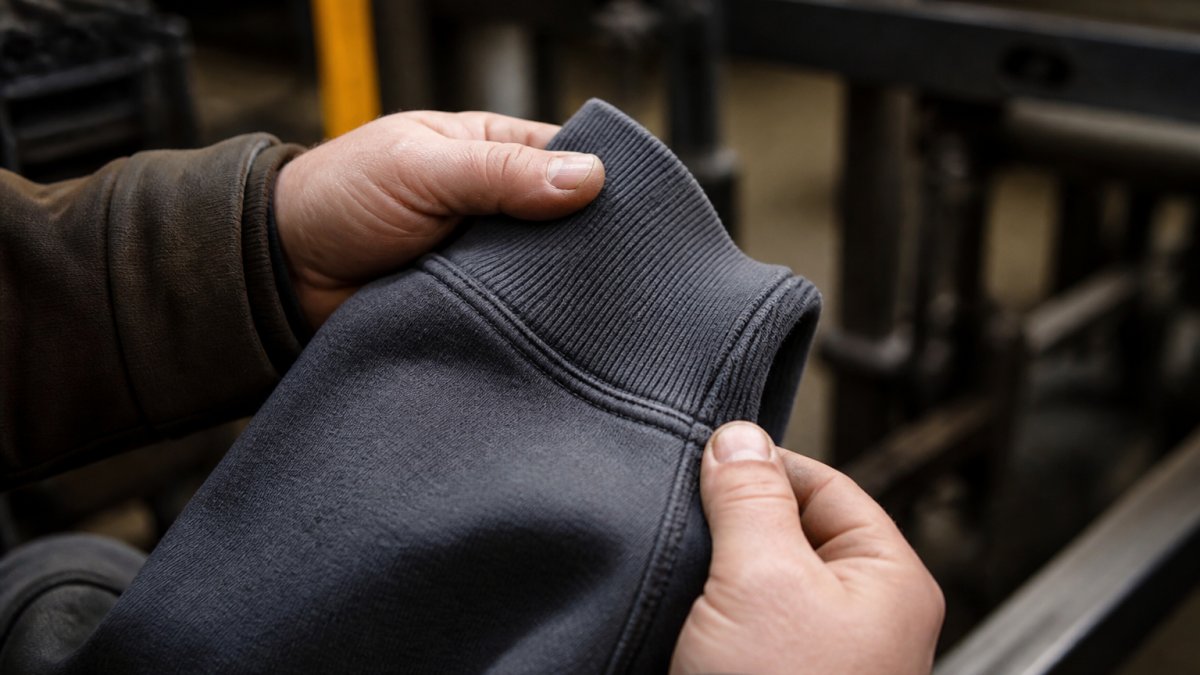
Thread and seam finish details worth asking about
Ask what thread is used. Bonded polyester thread resists UV and abrasion better than standard cotton-wrapped thread in work conditions. Ask whether seams are pressed or taped at the neck; a taped neck seam reduces chafe and stretch failure.
Our Work Hard Zip Up Hoodie pairs a heavy 9.7 oz body with ribbed cuffs and waistband that hold their tension, and the seams are built to pass the tug and zip tests above.
Get the Work Hoodie Fit for Layering Right
A work hoodie fit for layering should let you raise your arms overhead without the hem riding up or the shoulders binding. Size for movement, not just your chest measurement.
Quick fit check:
- Raise both arms: does the hem stay near your waist?
- Cross your arms: do the shoulders pull tight?
- Try it over a base layer: is there room without bulk?
Sizing consistency is the other half of fit. We list our hoodies from Small through 3XL, and some styles run to 5XL.
Plan Hoodie Care and Washing to Extend Its Life
Hoodie care and washing decides whether a good hoodie lasts two seasons or ten. Heat is the enemy. Wash cold, tumble low, and skip the fabric softener, which coats fibers and traps lint.
A simple routine:
- Turn the hoodie inside out before washing
- Use cold water and a mild detergent
- Tumble dry on low or hang to dry
Test for shrinkage by measuring the sleeve and body length before the first wash and after. A well-made blend should hold within a small margin. If it shrinks dramatically, the fabric wasn't pre-shrunk properly.
Use a Durability Checklist and Cost-Per-Wear Math
Most guides stop at a feature list. A work hoodie needs a repeatable inspection method plus a safety screen.
The pre-purchase durability checklist
Run this in order. Any fail is a reason to walk away.
- Fabric weight stated in GSM or ounces, no number, no purchase
- Blend disclosed, cotton-poly for high-wear use; pure cotton only for low-friction layering
- Knit density, surface looks tight, not lofty and fuzzy
The jobsite safety screen
A standard hoodie is not automatically suitable for every worksite. Before you buy, answer these:
- Visibility: does the site require high-visibility garments? A standard hoodie in a dark color may not meet the requirement, and layering a vest over a bulky hoodie can restrict movement.
- Flame resistance: if the site requires flame-resistant clothing, a standard cotton-poly hoodie is not a substitute. Polyester can melt and adhere to skin under heat exposure, which is why FR-rated garments use specific fiber blends and treatments.
- Snag and entanglement risk: drawcords, loose cuffs, and roomy hoods can catch on rotating equipment, conveyors, or lift mechanisms. Some sites require cord-free or breakaway designs.
Cost-per-wear math you can actually run
Cost per wear is the honest way to judge value. Divide the purchase price by the number of wears you expect before replacement.
A simple method:
- Estimate wears per week (be realistic, most people overestimate).
- Multiply by the months you expect the hoodie to stay serviceable.
- Divide the price by that total.
A hoodie worn twice a week for two years is roughly 200 wears. A lower upfront price with a one-season life often costs more per wear than a higher-priced hoodie that lasts three seasons, especially once you count replacement trips and the risk of a mid-shift failure.
Repairability and replacement value
Ask whether the hoodie can be repaired. Cuffs and zippers are the first parts to fail, and a garment with replaceable or easily repaired hardware extends service life.
Work-specific abrasion resistance, frequent laundering, and jobsite compatibility are the angles most guides skip. Ask whether the hoodie needs to fit under safety gear, whether it snags on equipment, and how it handles a wash cycle after every shift.
Shop Hellanbach Hoodies Built for the Job
You've got the criteria. Now match them to real gear. Our hoodies are built on heavyweight cotton blends with reinforced seams and ribbed cuffs that hold up to daily wear.
Here's where to start: Live To Ride Mens Zip Up Hoodie for a final zip-up to consider. Speed Shop Mens Zip Up Hoodie to shop a specific zip-up. Hell Bent Mens Zip Up Hoodie for another zip-up option to compare. Built Fast Mens Zip Up Hoodie for a durable zip-up option.
- Built Fast Bagger Pullover Hoodie for a pullover hoodie
- No Guts No Glory Hooded Pullover for another pullover hoodie option
- Behind Bars Pullover Hoodie for a classic pullover hoodie
- Work Hard Zip Up Hoodie for a zip-up hoodie
Every order comes with our 100% satisfaction guarantee and encrypted checkout, so you can buy with confidence.


Frequently Asked Questions
Is a cotton-polyester blend durable enough for a work hoodie?
Yes. A cotton-polyester blend often outlasts pure cotton because the polyester adds abrasion resistance and helps the fabric hold its shape through repeated washing. Look for a high-stitch-density knit with a cotton face, like the 90/10 and 80/20 blends used in Hellanbach hoodies, which are built to resist pilling and wear. Blends in the 300 to 450 GSM range give you the weight and durability most jobs demand.
What fabric weight should I look for in durable work hoodies?
Aim for 300 to 450 GSM, or roughly 9 to 10 ounces per square yard. Lighter hoodies under 250 GSM wear through faster at the cuffs, elbows, and hem. Heavier knits resist abrasion and hold warmth, but they can feel stiff for layering. A 9.7 oz. heavyweight cotton hoodie is a practical middle ground for most manual labor and outdoor work.
How should a work hoodie fit for layering?
Size up one step from your everyday fit if you plan to wear a base layer or flannel underneath. The shoulder seams should sit at the edge of your shoulder, and you want enough room in the chest and arms to reach overhead without the hem riding up. A relaxed waistband and stretch cuffs keep the hoodie in place without restricting movement on the job.
How do you wash a work hoodie without wearing it out?
Turn it inside out, wash cold on a gentle cycle, and skip the fabric softener, which coats fibers and reduces breathability. Tumble dry low or hang dry to limit shrinkage and pilling. Wash it with similar colors and avoid overloading the machine, since friction between garments speeds up wear. Following hoodie care and washing basics like these can add years of use to a heavy 9.7 oz. cotton hoodie.
Choosing gear that survives real work shouldn't be a gamble. At Hellanbach, we build heavyweight hoodies with the fabric density, reinforced stitching, and fit that hold up shift after shift. Compare our zip-up and pullover styles, check the specs against the checklist above, and gear up with confidence. Get started with Hellanbach and wear a hoodie built to last.