




 214-274-5008
Table of Contents
- Quick Comparison: Rugged Motorcycle Apparel at a Glance
- What Makes Apparel Rugged Enough for the Road
- Heavyweight Shirts for Motorcycle Riders: Why Fabric Weight Matters
- Motorcycle Riding Gear Safety Standards: What Labels Actually Mean
- Rugged Apparel for Motorcycle Riders by Category
- Fit Guide: Getting Sizing Right the First Time
- Caring for Technical Fabrics: Washing, Drying, and Re-Waterproofing
- Conclusion
- Frequently Asked Questions
Last Updated: September 15, 2026
Quick Comparison: Rugged Motorcycle Apparel at a Glance
Rugged apparel for motorcycle riders is clothing built to survive both the road and the ride: abrasion-resistant fabrics, reinforced stitching, and armor pockets that hold up when you go down. This guide from Hellanbach breaks down what actually matters when you're buying gear, from fabric weight to safety labels to fit.
Here's the short version before we get into the details:
| Category | What It Does | Key Spec to Check | Hellanbach Pick |
|---|---|---|---|
| Riding Shirts | Outer layer, abrasion resistance | Fabric weight, stitching | Built Fast Work Shirt |
| Hoodies / Mid-Layers | Insulation, layering | Fabric weight (oz), breathability | Reaper Hooded Pullover |
| Headwear | Wind, sun, debris protection | Fit, material | Richardson Snapback Trucker |
| Accessories | Neck, face coverage | Breathability, material | Built Fast Bandana V2 |
The categories above are where most riders start, and the specs in the middle column are the ones that separate gear that lasts from gear that doesn't. Below, we'll show you exactly how to read those specs, what the safety labels mean, and how to get your sizing right the first time.

What Makes Apparel Rugged Enough for the Road
Rugged motorcycle apparel is defined by three things: how well the fabric resists abrasion, how strong the stitching and hardware are, and how the layers work together. Miss any one of those and you've got a shirt, not riding gear.
Abrasion Resistance, Stitching, and Hardware
Abrasion resistance is the fabric's ability to withstand sliding contact with asphalt without wearing through. Heavier fabrics and tighter weaves resist abrasion better than lightweight ones. The Motorcycle Safety Foundation's rider resources notes that protective clothing is a core part of rider safety, not an accessory.
Stitching matters just as much as fabric. High-tensile stitching, bar tacking at stress points, and double-needle seams keep a garment from coming apart at the seams during a slide. Hardware like metal snaps and reinforced buttons should be corrosion-resistant and securely attached.
Layering: Base, Mid, and Outer
A three-layer system gives you the most flexibility across temperatures and conditions:
- Base layer: Moisture-wicking material against the skin, moves sweat away so you stay dry
- Mid layer: Insulation, often a hoodie or fleece, traps warmth without bulk
- Outer layer: Abrasion-resistant shell that takes the impact and wind
Versatile layering means you can add or remove pieces as the weather shifts, rather than owning five separate jackets.
Heavyweight Shirts for Motorcycle Riders: Why Fabric Weight Matters
Fabric weight is measured in ounces per square yard, and it's the single best predictor of how a shirt will hold up on the road. Heavier fabric resists abrasion, holds its shape, and blocks wind better than lightweight alternatives.
A 9.7 oz. cotton hoodie, for example, sits at the heavy end of the spectrum. That weight translates to durability and warmth, but it also means less breathability, which is why heavyweight pieces work best as mid-layers rather than standalone summer gear.
For riding shirts, look for fade-resistant poly/cotton blends that resist wrinkling and hold up to repeated washing. The Textile Exchange's materials guidance explains how fiber blends affect durability and care, which matters when you're washing gear weekly.
Motorcycle Riding Gear Safety Standards: What Labels Actually Mean
Motorcycle riding gear safety standards are the testing frameworks that tell you how much protection a garment or armor piece actually provides. In the U.S., the DOT's motorcycle safety guidance covers helmet standards, while CE ratings cover body armor and, increasingly, the abrasion and tear resistance of the garment itself.
The confusion most riders hit is that "CE" gets used for two different things: armor protectors and garment construction. They are tested separately, and a jacket can pass one while failing the other.
Armor Protectors: Level 1 vs. Level 2
Impact protectors are tested for the force transmitted through the armor to a standard anvil. The two common tiers:
- CE Level 1: Baseline impact protection, tested for lower-speed impacts. Typically thinner and more flexible, which is why it shows up in streetwear-inspired gear.
- CE Level 2: Higher impact absorption, tested at greater force. Usually thicker, stiffer, and heavier, the trade-off is comfort and packability.
A "CE-certified" label on armor means the protector passed a standardized impact test. It does not mean the entire garment is certified. That distinction trips up a lot of buyers.
Garment Abrasion and Tear Ratings
Separate from armor, the shell fabric itself is tested for how many seconds it survives sliding contact before wearing through. Abrasion ratings are expressed in seconds of slide time, and tear resistance is measured in newtons of force required to propagate a rip. A garment rated for a longer slide time is not automatically better for every rider, heavier, higher-rated shells are also hotter and less breathable, which matters more in humid climates than dry ones.
Coverage Area Matters as Much as the Rating
A Level 2 protector that sits two inches off your shoulder joint protects less than a Level 1 protector positioned correctly. Armor only works where it stays put during a slide, which is why pocket placement, strap adjustment, and garment fit are part of the safety equation, not just the label on the insert.
What to Check Before You Buy
- Confirm the armor is included, not just the pocket
- Check whether the rating is Level 1 or Level 2, and whether it applies to the protector or the shell
- Look for abrasion and tear ratings on the garment tag, not just the marketing copy
- Verify the armor stays in place when you move your arms and shoulders through a riding posture
If a product page only says "CE-certified" without specifying which component was tested, treat that as an incomplete spec, not a guarantee.
Rugged Apparel for Motorcycle Riders by Category
Every category of riding apparel solves a different problem, and the best setup combines pieces from several. Here's how to think about each one.
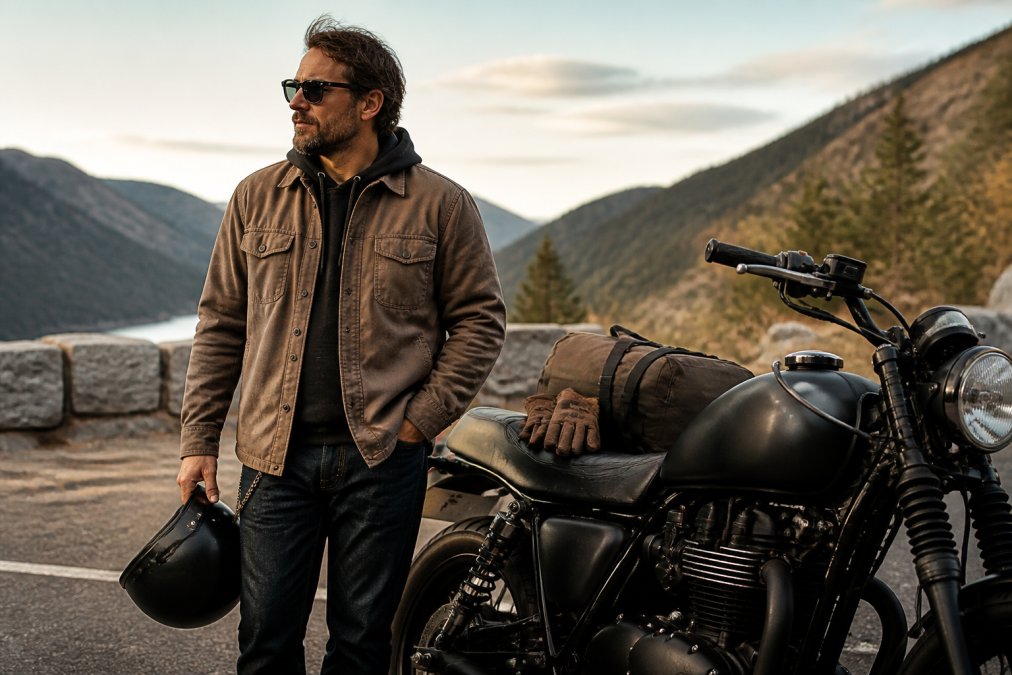
Work Shirts and Riding Shirts
Work shirts pull double duty as riding shirts because they're built with the same priorities: durable construction, fade resistance, and hardware that survives abuse. The Hellanbach Built Fast Work Shirt is made from permanent press poly/cotton poplin that resists wrinkling and fading, with mitered front pockets and bar tacking at stress points to prevent tears.
For riders who want a graphic edge, the Iron Skull Work Shirt and Reaper Work Shirt use the same construction with different designs. If you want a heavier 65/35 poly/cotton blend with a 3D patched chest, the Work Hard Red Kap Work Shirt adds stain release and wickability.
Hoodies and Mid-Layers
Hoodies are the workhorse mid-layer for most riders.
Headwear and Accessories
Fit Guide: Getting Sizing Right the First Time
Armor Placement by Body Type
How Climate Should Drive Your Material Choice
Caring for Technical Fabrics: Washing, Drying, and Re-Waterproofing
Conclusion
Frequently Asked Questions
What is the best protective clothing for motorcycle riders?
The best protection combines CE-certified armor at the shoulders, elbows, hips, and knees with abrasion-resistant outer fabric. Full-grain leather or reinforced denim works for the outer layer, and a rugged apparel base like a heavyweight shirt or hoodie adds comfort and coverage underneath. Look for impact protection at joints, high-tensile stitching, and a fit that keeps armor in place without restricting movement. No single piece covers everything, so layer deliberately from base to outer.
Are heavyweight shirts for motorcycle riders actually safer than regular shirts?
Heavier fabric resists abrasion longer and holds its shape at speed, so it stays in place instead of flapping or riding up. A 9.7 oz. cotton hoodie or a poly/cotton work shirt with bar-tacked seams gives more coverage than a thin tee, though neither replaces CE-certified armor. Think of heavyweight shirts as a durable base layer that reduces skin exposure and adds warmth, not as standalone crash protection.
What do motorcycle riding gear safety standards actually require?
In the U.S., the DOT sets the FMVSS 218 standard for helmets, and CE ratings from Europe are widely used as a benchmark for armor and abrasion resistance. CE Level 1 armor absorbs less impact energy than Level 2, so Level 2 is worth the upgrade for highway riding. Check that armor is marked and removable, and confirm the garment lists abrasion-resistant fabric and reinforced seams at impact zones.
How do I choose durable motorcycle riding gear that lasts?
Start with fabric and construction, not logos. Look for abrasion-resistant fabric, high-tensile stitching, bar-tacked stress points, and hardware that will not rust. Removable armor lets you wash the shell without degrading the pads. Then match material to climate: breathable mesh for summer, a waterproof membrane for wet commutes, and thermal layers for cold mornings. Care matters too. Wash cold, air dry, and reapply water repellent as needed.
Can rugged apparel do double duty off the bike?
Yes, and that is part of the appeal. A poly/cotton work shirt or a 9.7 oz. hoodie looks at home at a job site, a diner, or a bike night. Choose pieces with a street-legal, streetwear-inspired cut, then add armor underneath for rides. This keeps your gear budget focused on a few versatile items instead of a closet full of single-purpose clothing.