

 214-274-5008
Last Updated: November 5, 2026
Quick Summary
To verify an american made clothing label, read the permanent tag inside the garment, not a removable hangtag. Check whether the claim is unqualified or qualified, confirm where it was cut and sewn, and compare the origin wording with the fiber content and the brand's product page.
- Check the permanent neck or side-seam tag, since hangtags can be removed or swapped.
- An unqualified Made in USA claim generally means all or virtually all of the garment is domestic.
- Assembled in USA often means the fabric or components may have been imported.
- Compare the fiber content on the care label with the origin claim to spot mismatches.
- Save product pages and tag photos, then ask the brand specific questions in writing.
Table of Contents
- What a Made in USA Clothing Label Actually Requires
- Step 1: Read the Tag and Care Label Together
- Step 2: Check Where the Garment Was Cut, Sewn, and Assembled
- Step 3: Separate Made in USA from Assembled in USA
- Step 4: Look at Fiber Content and Imported Fabric
- Step 5: Test a Brand's Sourcing Claims Beyond the Label
- What to Do When a Label Looks Misleading
- Shopping With Hellanbach's American-Made Lineup
- Frequently Asked Questions
What a Made in USA Clothing Label Actually Requires
A "Made in USA" label sounds simple, but it carries real legal weight. Federal rules set the standard, and the Federal Trade Commission (FTC) enforces it through its Made in USA Labeling Rule guidance. Before you trust a tag, it helps to know what the phrase is actually promising.
Here is the short version. Some "american made clothing" claims are unqualified, and some are qualified. Each one tells you something different, and each one is held to a different standard.
Unqualified versus qualified U.S-origin claims
An unqualified claim is a plain "Made in USA" with no limits attached. An unqualified claim is generally understood to mean that the product is all or virtually all made in the United States.
A qualified claim adds a limit, such as "Made in USA of U.S. and imported parts" or "Sewn in USA with imported fabric." These claims are more honest about what happened, but they still need to be accurate. Read the qualifier closely, because it tells you which part of the garment came from where.
The all-or-virtually-all standard
"All or virtually all" is the benchmark usually associated with an unqualified claim, and it means the finished garment should have no more than a negligible amount of foreign content. For clothing, that generally turns on where the fabric was made, where the cutting and sewing happened, and where the trims and components came from.
The substantial-transformation principle
A related idea is substantial transformation. A product is not automatically domestic just because it was assembled here. If imported fabric or components are merely combined or finished in the United States without being fundamentally changed, the FTC may not treat the result as U.S.-made. The question is whether the domestic work created a new and different article, not just whether the last step happened on American soil.
Why the wording matters to you
Think of the label as a set of promises. The unqualified version promises the most. A qualified version promises less, but it should say exactly what it covers. When you compare an american made clothing tag against a product page, you are checking whether the promise on the label matches the standard behind it. The same habit of matching each label’s promise to the standard behind it can help when checking American made pet products.
Watch out: a bold "Made in USA" with a tiny qualifier buried elsewhere on the tag is a common pattern, and the qualifier is the part that actually limits the claim.
Step 1: Read the Tag and Care Label Together
Start with the physical tags. Hold the garment up in good light and look at the inside neck tag, the side seam label, and any hangtag still attached. The care label usually sits on a separate tag, and it lists fiber content and care instructions. Read both, because they often tell different parts of the story.
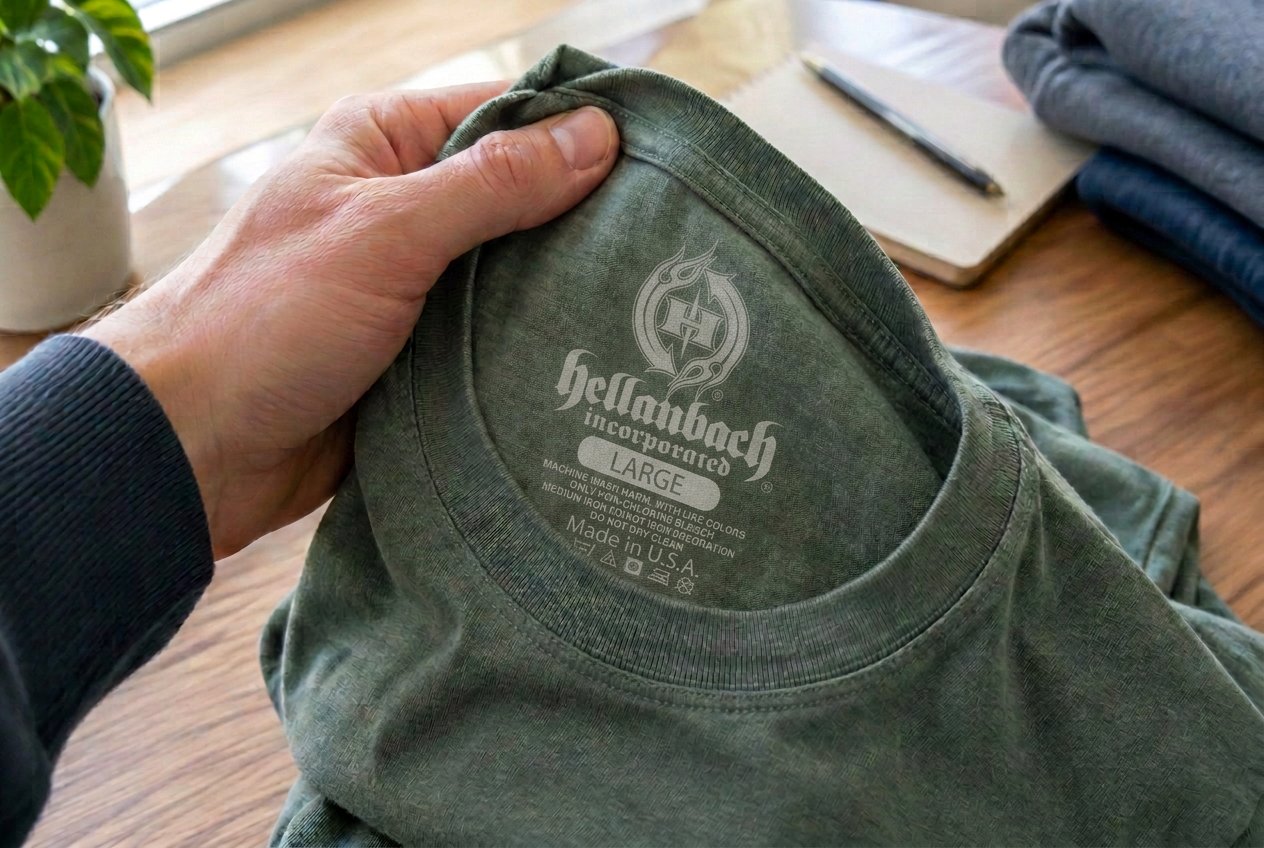
Hand holding a cotton t-shirt to reveal the inside neck tag and care label in soft natural window light.
Look for the country-of-origin statement and the fiber content. A country-of-origin statement is required on imported goods, and the fiber content on a care label shows what the garment is made from.
Watch out: a "Made in USA" phrase printed on a hangtag is not the same as one sewn into the garment. Hangtags can be removed or swapped, so confirm the claim on the permanent label.
A quick checklist:
- Is "Made in USA" printed or woven into the inside neck or side seam?
- Does the care label show fiber content?
- Do the fiber content and origin claim match each other?
- Is the text clear and easy to read?
Step 2: Check Where the Garment Was Cut, Sewn, and Assembled
A garment can have many steps: cutting, sewing, washing, printing, and packaging. A claim should match where the key manufacturing happened. For apparel, cutting and sewing usually matter most.
Check the brand's product page for details about where the shirt was cut and sewn. A transparent brand usually explains this in plain language. If the page is vague, that is a warning sign.
Many shoppers assume the phrase covers every step, but that is not always true. Ask whether the claim covers just the final assembly or the full construction.
Step 3: Separate Made in USA from Assembled in USA
These two phrases sound alike but mean different things. "Assembled in USA" usually means the final sewing or putting-together happened here, while the cloth or components may have come from overseas. "Made in USA" without a qualifier suggests much more domestic content.
Ask yourself which phrase appears on the label. If it says "assembled," the fabric may be imported. If it says "made," the claim should cover more of the process. Compare the wording on the tag with what the product page describes.
Shoppers often find the difference confusing, so keep this rule of thumb: the more specific the qualifier, the more useful the information.
HB Nation "What A Ride" Mineral Washed Premium Shirt →
Step 4: Look at Fiber Content and Imported Fabric
Fiber content often reveals where the fabric may have come from. A shirt labeled 100% cotton does not tell you where that cotton was grown or spun. Still, the fiber content and the origin claim should make sense together.
If a garment says "Made in USA" but the fabric is listed as imported, the label may be qualified in a way the tag does not show clearly. Look for a qualifier near the origin claim, and look for a fabric or textile origin statement on the care label.
Compare these questions when you shop:
- What is the fiber content? The care label lists it.
- Does the origin claim cover the fabric? Check the product page or label wording.
- Is the fabric imported? A qualified claim should say so.
The table below summarises the three checks to run on fiber content and fabric origin.
Question |
Where to look |
What it tells you |
|---|---|---|
What is the fiber content? |
Care label |
What the garment is made from |
Does the origin claim cover the fabric? |
Product page or label wording |
Whether fabric is included in the claim |
Is the fabric imported? |
Qualifier near the origin claim |
Whether the claim is qualified |
Step 5: Test a Brand's Sourcing Claims Beyond the Label
A label alone may not settle the question. The strongest verification combines what the tag says with what the brand discloses and what it will confirm in writing. This is the step most shoppers skip, and it is where a clear answer separates a careful brand from a vague one.
Build a small evidence file
Before you buy, save the product page as a PDF or screenshot it, note the date, and keep the tag photos you took in Step 1. If a claim later looks wrong, that file is your record of what the brand said at the time of purchase.
Ask the brand specific questions
A short email works better than a broad one. Ask where the garment was cut and sewn, where the fabric was woven or knit, and which components were imported. Ask whether the origin claim on the tag is qualified or unqualified. A transparent brand usually answers in plain language and points to a factory or region. A vague reply that repeats the slogan is a warning sign.
Check the product-specific disclosures
Look for a sourcing or materials page, a factory list, or a country-of-origin note on the product page itself. Compare that wording with the sewn-in tag. If the page says "imported fabric" but the tag reads as unqualified, ask the brand to reconcile the two before you buy.
Know where to take a concern
If a claim still looks misleading after you ask, you can report it. The FTC's consumer complaint process accepts reports about deceptive origin claims. Keep your photos, screenshots, and email replies together so the record is complete.
Watch out: a brand that answers questions only through a generic contact form, with no specifics about cutting, sewing, or fabric origin, is giving you less to verify than one that names where the work happened.
What to Do When a Label Looks Misleading
Sometimes the wording is confusing on purpose, or it just looks wrong. Common warning signs include a bold "Made in USA" next to a tiny qualifier, a claim that contradicts the fiber content, or a brand that avoids answering direct questions.
When a claim looks misleading, take these steps:
- Photograph the tags and product page.
- Compare the claim with the fiber content and any qualifier.
- Ask the seller for sourcing details in writing.
- Report a concern to the FTC if the claim seems false. The agency's consumer complaint process accepts reports about deceptive origin claims.
Keep records of your findings. They help if you need to return an item or raise a complaint.
Shopping With Hellanbach's American-Made Lineup
If you want American-made apparel with clear labeling, start with the HB Nation "What A Ride" Mineral Washed Premium Shirt. It is made 100% in the USA, and the product listing includes its fabric blend and sizes so you can check the details yourself.

HB Nation "What A Ride" Mineral Washed Premium Shirt
Other options from our lineup include the American Patriot Work Shirt, the American Patriot Zip Up Hoodie, and the Hellanbach 3D Men's Work Shirt. Compare each listing's origin wording and fiber content against the steps above. Our customers often mention the fit and quality, and our 100% satisfaction guarantee covers your order.


Use the checklist in this guide on any brand you consider, including ours. A label you can verify is worth more than a slogan.
Frequently Asked Questions
How can you tell if clothing is really made in the USA?
Start with the label, then check the brand's sourcing details. Look for an unqualified Made in USA statement, which the FTC says must be accurate for the product as a whole. Then read the care and fiber content labels, which must identify imported materials. A label alone rarely settles the question, so compare it with the brand's product page and ask direct questions about where cutting and sewing happen.
Does "assembled in the USA" mean a garment is made in the USA?
Not necessarily. Assembled in USA usually means final sewing or assembly happened domestically, while some components or materials may have come from overseas. A Made in USA claim carries a stricter standard. Read the exact wording on the label and treat assembled-only claims as a narrower statement about where the garment was put together.
Can clothing made with imported fabric be labeled Made in USA?
Sometimes, but only with a qualifying statement. If the product uses imported fabric, the label should say so, such as Made in USA of imported materials. The FTC evaluates whether an origin claim is nondeceptive in context, so an unqualified Made in USA label on a garment with significant imported content can be misleading.
Where can consumers report a misleading origin claim?
You can report suspected misleading Made in USA claims to a consumer protection agency. Include the brand name, the product, a photo of the label, and where you bought it. Keep your order confirmation and any product page screenshots, since they document how the claim was presented.