

 214-274-5008
Last Updated: November 2, 2026
Quick Summary
Durable headwear for outdoor manual labor is a hat built to survive sweat, sun, abrasion, and repeated washing without losing its shape, stitching, or fit. Look for a structured front with a mesh or eyelet-vented back, a sweatband that holds its shape, and sized options rather than one-size-fits-all. A work cap handles sun, sweat, and abrasion; a hard hat handles anything that can fall on you.
- Cotton-polyester twill resists abrasion and holds color; all-cotton caps break down faster under sweat and UV.
- Flexfit caps come in S/M, L/XL, and XL-XXL with a spandex sweatband that holds its shape.
- OSHA requires protective helmets where falling objects or electrical shock are risks.
- Match hard hat class to electrical exposure first, then pick type for the impact profile.
- Hand wash in cool water with mild soap and never machine dry a structured cap.
Table of Contents
- What Makes Headwear Durable Enough for Outdoor Manual Labor?
- Quick Comparison: Hellanbach Work Hats Side by Side
- Hard Hats for Construction Workers: When a Cap Is Not Enough
- Breathable Work Hats for Hot Weather and Long Shifts
- Do You Need a Wide Brim Work Hat on the Job?
- How to Clean a Work Hat Without Wrecking the Shape
- Pick the Hellanbach Hat That Matches Your Worksite
- Frequently Asked Questions
What Makes Headwear Durable Enough for Outdoor Manual Labor?
Durable headwear for outdoor manual labor is a hat built to survive sweat, sun, abrasion, and repeated washing without losing its shape, stitching, or fit. The global headwear market hit $37.0 billion in 2025 and is projected to reach $39.4 billion in 2026, according to Grand View Research's headwear market forecast, which tells you one thing: there is no shortage of hats.
At Hellanbach, we build headwear for people who actually work in it, and we have strong opinions about what separates a hat that survives a season from one that quits in a month.
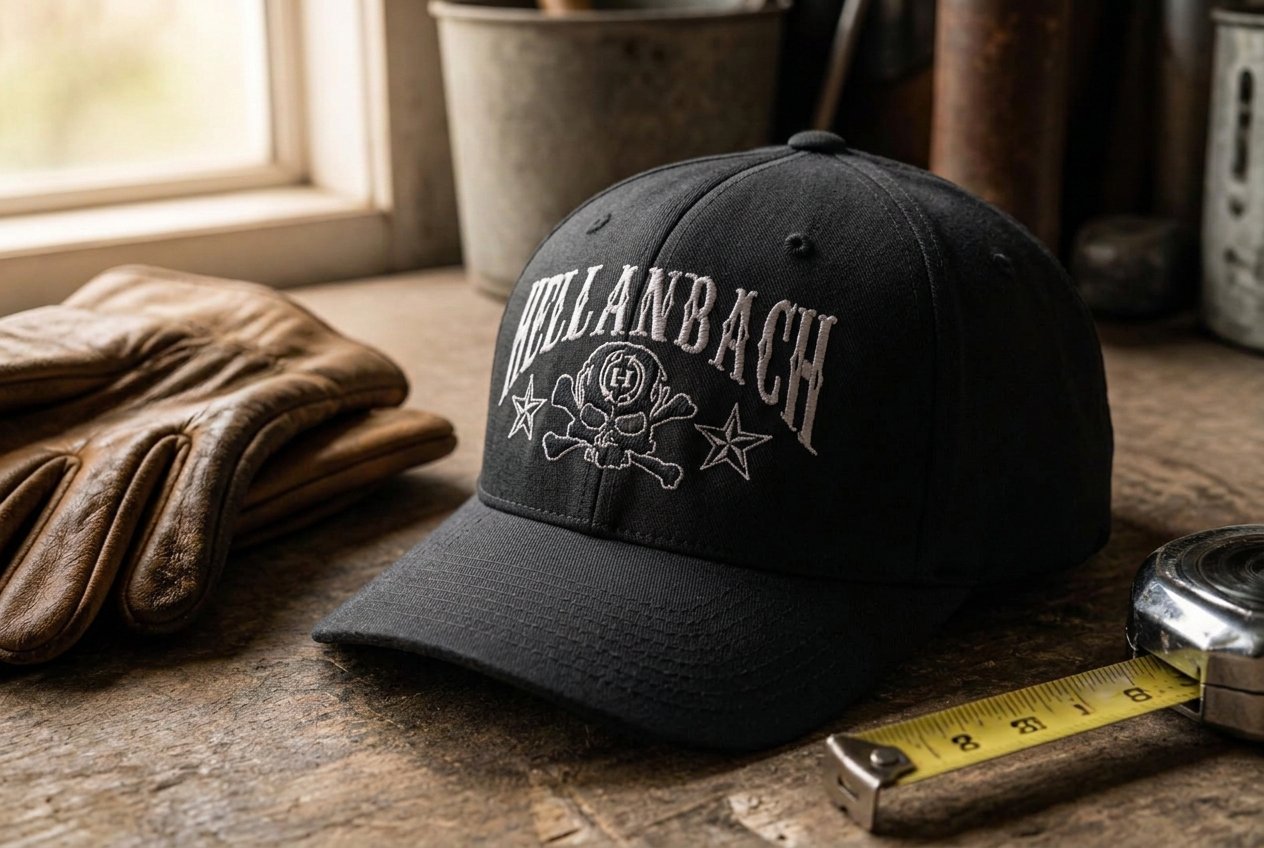
Weathered ball cap with reinforced stitching resting on a workbench beside leather gloves and a tape measure
Materials That Survive Sweat, Sun, and Abrasion
The shell material decides everything. Cotton-polyester twill resists abrasion and holds color; all-cotton caps breathe but break down faster under sweat and UV.
Our Flexfit line uses a 63% polyester, 34% cotton, 3% spandex combed twill with hard buckram-backed front panels and eight-row stitching on the bill. That blend is the reason those caps keep their crown shape after a summer of sweat.
Fit and Suspension: The Part Most Buyers Skip
Fit is where cheap hats fail. A cap that shifts means you adjust it all day, and a sweatband that stretches out means it never sits right again.
Our Flexfit caps come in S/M (6 3/4" to 7 1/4"), L/XL (7 1/8" to 7 5/8"), and XL-XXL (7 3/8" to 8") on select colors, with a spandex sweatband that holds its shape.
Quick Comparison: Hellanbach Work Hats Side by Side
Here is the whole lineup at a glance, so you can match a hat to your worksite instead of guessing.
Hat |
Price |
Material |
Best For |
|---|---|---|---|
$34.95 |
98% cotton / 2% P.U. spandex |
Concealment-friendly outdoor work |
|
$32.95 |
Cotton-poly twill / trucker mesh |
Hot days, adjustable fit |
|
$34.95 |
Poly-cotton-spandex twill |
All-around daily wear |
|
$32.95 |
Poly-cotton-spandex twill |
Budget pick, solid colors |
|
H2C, H3, H4, H5, H6, High Voltage Flexfit |
$31.95-$34.95 |
Poly-cotton-spandex twill |
Logo and color preference |
The Richardson 112 is a six-panel snapback with a precurved bill, a cotton-polyester twill front and trucker mesh back, and an adjustable snapback closure. The Flexfit solids feature a 3½" crown and hard buckram-backed front panels.


Hard Hats for Construction Workers: When a Cap Is Not Enough
A ball cap is not head protection. Hard hats for construction workers are certified safety helmets, and they are regulated, not optional. The OSHA head protection standard requires employers to make sure employees wear protective helmets where there is a risk of falling objects or electrical shock. That is the line: a work cap handles sun, sweat, and abrasion; a hard hat handles anything that can fall on you or energize you.
Type and Class, Mapped to Real Outdoor Hazards
Hard hats are classified by type and class, and the two letters answer different questions. Type describes what the shell protects against; class describes electrical performance.
A common pattern is to see a crew in Class C vented hats on a site with overhead lines. That is a class mismatch, not a comfort choice. Match the class to the electrical exposure first, then pick the type for the impact profile.
Shell Materials and Suspension
Shells are typically high-density polyethylene or ABS plastic. High-density polyethylene is tough, lightweight, and resistant to most chemicals; ABS is stiffer and holds a molded shape well but can be more brittle in extreme cold.
Suspension systems range from four-point to six-point. More points spread impact force across a larger area of the head, and a ratchet or pin-lock adjustment holds fit better than a friction-fit strap.
What You Wear Under the Shell Matters
Here is the part most guides miss: what you wear under the shell matters. OSHA recommends employers permit only liners specifically designed to be compatible with the hard hat's protective properties, per a 2006 OSHA standard interpretation. A thick beanie or an ordinary cap worn underneath can interfere with the suspension and the fit, and a poor fit means the shell does not sit where it was tested to sit.
Inspection and Replacement
Hard hats are not buy-once equipment. A common pattern among safety practitioners is to inspect the shell and suspension before each use for cracks, gouges, chalky or faded plastic, and stretched or torn suspension straps, and to replace the suspension more often than the shell.
Use a work cap for sun, sweat, and abrasion. Use a hard hat when something can fall on you, and match the type and class to the hazard before you put it on.
Breathable Work Hats for Hot Weather and Long Shifts
Breathable work hats for hot weather come down to three things: airflow through the shell, a sweatband that wicks instead of soaks, and a bill that keeps sun off your face without trapping heat. Mesh backs and sewn eyelets do most of the work, but the difference between a hat you forget you are wearing and one you resent by noon is in the details most product pages skip.
Flexfit Alpine White Camo Hat →
Where the Air Actually Moves
A hat vents in three places, and each one behaves differently over a long shift:
- Mesh back panels move the most air but offer the least structure and the least sun protection on the back of the head. On a trucker-style cap, the mesh is doing the heavy lifting for heat and almost nothing for UV.
- Sewn eyelets in a structured crown move a small, steady amount of air. They matter most when the crown is buckram-backed and would otherwise be a sealed dome.
- The sweatband is not a vent, but it is the part that decides whether sweat runs into your eyes or gets absorbed and released. A band that wicks keeps the forehead drier; a band that soaks becomes a wet ring that stays wet for hours.
The All-Day Wear Trade-Off
There is a real trade-off between breathability and structure, and most guides pretend there is not. A fully mesh back breathes best but sags and offers little sun protection on the neck.
A soaked cotton sweatband left in a hot truck overnight turns into a stiff, salty band by morning. Rinse it and air-dry it, and it will last years.
Heat, Sweat, and the Rest of Your Gear
Heat management does not stop at the hat. If you wear hearing protection, eye protection, or a respirator, the hat has to coexist with them:
- Earmuffs and helmet-mounted hearing protection need a shell or band that does not fight the hat's fit. A cap with a low crown and a snug closure is easier to pair with muffs than a tall, loose crown.
- Safety glasses sit on the ears and the bridge of the nose. A hat that rides low can push the temples of the glasses out of position, which is a fit problem, not a lens problem.
- Respirators rely on a clean seal. A sweatband that drips onto the face or a bill that channels sweat toward the mask undermines the seal over a shift.
The Richardson Snapback Trucker is an adjustable six-panel snapback with a cotton-polyester twill front and polyester trucker mesh back, which you can loosen or tighten through the day. The Flexfit caps are structured with hard buckram-backed front panels.
Do You Need a Wide Brim Work Hat on the Job?
A wide brim work hat is worth it when sun exposure is the main hazard, not falling objects.
The tradeoff is wind. A user reviewing the Outdoor Research Seattle Sombrero noted that a slight breeze could blow up its large, soft brim and expose them to the sun, per OutdoorGearLab's sun hat review coverage.
If you need brim coverage plus a secure fit, choose a hat with a structured front and a snug closure rather than a floppy full-brim.
How to Clean a Work Hat Without Wrecking the Shape
Cleaning a work hat is simple if you protect the structure: hand wash in cool water with mild soap, rinse the sweatband thoroughly, and air-dry it on a form or stuffed with a towel. Never machine dry a structured cap.
- Brush off loose dirt and dust before wetting the fabric
- Spot-clean stains with a soft cloth and mild soap
- Hand wash the sweatband, the part that holds salt and oil
Pick the Hellanbach Hat That Matches Your Worksite
Choosing durable headwear for outdoor manual labor gets easy once you match the hat to the hazard. Sun and sweat? Go breathable. Abrasion and concealment? Go structured and tough.
Our recommendation: start with the Hellanbach headwear lineup and pick by material and fit, not by logo.
You can browse the full range and find the cap that fits your job.
Frequently Asked Questions
What type of hat is best for outdoor work?
It depends on the hazard. For everyday wear, a structured ball cap like the Flexfit styles Hellanbach sells from $31.95 to $34.95 is a practical choice. A cap is not a substitute for head protection where objects can fall. Match the hat to the task rather than buying one for everything.
How do I choose durable headwear that actually lasts?
Check three things: fabric blend, stitching, and the sweatband. Hellanbach's Flexfit caps use a 63% polyester, 34% cotton, 3% spandex combed twill with eight-row stitching on the bill and a spandex sweatband that retains shape. The camo Flexfit uses 98% cotton with 2% spandex.
Are wide-brim hats suitable for outdoor labor?
A wide brim work hat gives the best sun coverage for the neck and ears, which matters on long outdoor shifts. The trade-off is wind: a soft, wide brim can lift in a breeze and expose your face, a complaint users have raised about soft-brim rain hats. On windy sites, a structured cap worn with sunscreen and a neck cover is often more reliable.
What is the difference between a hard hat and a bump cap?
A hard hat is tested head protection for falling objects and must meet ANSI Z89.1, which OSHA enforces on construction sites. A bump cap is a soft cap with a thin insert that guards against scrapes and minor knocks, not impact from falling objects. Bump caps suit low-risk maintenance work; they are not a hard hat substitute.
How should I clean and maintain a work hat?
Hand wash in cool water with mild soap, scrub the sweatband with a soft brush, and air dry away from direct heat so the crown keeps its shape. Do not machine dry a structured cap. Wash every few weeks in summer, and inspect stitching and the sweatband monthly. Retire a hat when the brim warps or seams fray.
Your worksite does not care how a hat looks in a photo. It cares whether the crown holds, the sweatband survives, and the fit stays put through a 10-hour shift. Hellanbach builds headwear for exactly that, with structured Flexfit caps, shape-retaining sweatbands, and a 100% satisfaction guarantee backing every order. Get started with Hellanbach and put a hat on that can take the work.